Primates In Kibale National Park. Kibale Forest National Park is one of the best safari destinations in Africa for chimpanzee trekking safaris and has the highest number and diversity of primates in East Africa. There are 13 species of primates including chimpanzees living within its 795km2 land cover with the most beautiful and most diversified tracts of tropical forest in the whole of Uganda. The Forest covering predominates in the central and northern part of the park on the raised Fort Portal plateau. At the park’s northern tip, Kibale is highest and stands 1590m above sea level.
Vibrant Holiday Safaris gives you a clear insight of the 13 primates in Kibale.
Chimpanzee
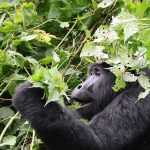
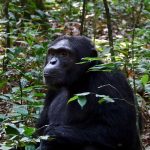
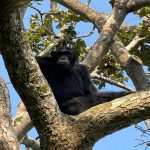
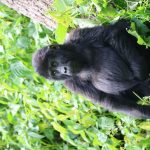
Kibale National Park is home to more than 1,000 chimpanzees, including about 80 habituated individuals that visitors can track. Humans share 98.7% of their DNA with chimpanzees, a close genetic relationship that shows in their laughter, hugs, facial expressions, and upright walking posture. Chimpanzees rank among the world’s most intelligent animals because they use tools creatively, such as leaves for umbrellas and sponges to collect water. Their habitat is usually rain forests and woodland savanna which explains why Kibale is has a dense population of chimps that you should not miss out on seeing.
Red Tailed Monkeys
People also know the red-tailed monkey as the spot-nosed monkey, red-tailed guenon, or black-cheeked white-nosed monkey. While these names describe its appearance, they reveal only part of what makes this primate unique. The red-tailed monkey has large cheek pouches that can hold nearly as much food as its stomach. It uses these pouches to store food and prevent other primates from stealing it. Their food is mostly fruit in the absence of which they eat leaves, roots, flowers, insects and tree gum.
L’ Hoest Monkeys
A short, dark grey coat covers most of the L’Hoest monkey’s body, while a striking white beard and a distinctive saddle-shaped pattern across its back make it easy to recognize. L’Hoest monkeys spend more time on the ground than most other monkey species, making them the most terrestrial monkeys in Africa. Like the red tailed monkeys, they too have large cheek pouches in which they store the fruits, leaves and shoots they will have gathered. You will find L’Hoest Monkeys in the thick underbrush of Kibale National Park since they prefer to live in a dense forest.
Black And White Colobus Monkeys
The name Colobus means mutilated; which is descriptive of the almost inexistent thumb on all primates that are referred to as Colobus. Born with white fur and a pin face, the Black and white Colubus Monkey grows a full black body and white beard, back and shoulders; thus the name Black and White Colubus Monkey. Kibale is abundant in these monkeys which are quite a sight to behold.
Grey Cheeked Mangabeys
People also know the grey-cheeked mangabey as the white-cheeked mangabey.Its general appearance is akin to that of a hairy baboon with a mane around its neck. Kibale and Semiliki National Park are the two places at which you the managabey can be trekked in Uganda. The grey-cheeked managabey is currently undergoing habituation to optimize the tourist experience of these amazing primates.
Blue Monkeys
There are 20 kinds of guenon monkeys and 3 of them are found in Uganda. Among these are the Blue monkeys. The name is descriptive of their dark-blue-grey colour. They have a white throat and bear a distinct patch of white fur on the chest. They live in troops of between 4 to 12 monkeys. While on a primate walk in Kibale national Park blue monkeys will be one of primates you’re ticking off your primate checklist.
Olive Baboons
Olive baboons are the only baboon species that live in Uganda, making them a must-see during your visit to Kibale National Park. They live in large troops and often forage along the roadside, giving visitors an excellent chance to observe them as they travel to the park. They generally look frightening because of their dog like heads and long scary teeth. You are likely not to miss a glimpse or photo of them while at Kibale National Park.
Vervet Monkeys
Greenish-olive and in the alternative, silver-grey will be the colours that will conform to you that it is a Vervet Monkey. The ears face, feet and tip of the tail however, are black. Kibale National Park is a perfect habitat for these monkeys because of the forest. Vervet Monkeys prefer to stay, eat and sleep in trees from which they rarely move making the Kibale Forest a perfect habitat for them. Like most primates, Vervet monkeys’ favorite pass time is grooming; removing parasites from each other’s’ fur with the dominant male Vervet monkey getting the most grooming. They are quite a spectacle and worth viewing while on a safari to Kibale National Park.
Demidoff Galago
“Bush babies,” are their more common name which is descriptive of their cries and the fact that they are Africa’s smallest primates. They have large eyes that aid their night vision, an acute sense of hearing and long tails that ease their balance. Like most primates, the Demidoff Galago is quite social living and sleeping in small groups of 10. Being nocturnal primates, you are likely to get a glimpse of them on a night primate walk.
Uganda Red Colobus
They will be leaping from tree to tree with their tails helping them balance. The appearance of a Uganda Red Colobus monkey is pretty much a rust red cap with a face that is between black and grey. They are Folivores meaning their diet is mainly leaves and in their scarcity, fruits and small invertebrates. Kibale National Park has the largest population of the Uganda Red Colubus in East Africa.
The Potto
It is another small primate that can reach the length of 14 inches and a weight of 1.8 to 3.5 pounds. It prefers to live in dense tropical rainforests but can also be found in mountain forests and near rivers. A baby Potto is born white and creamy but grows into a grey, reddish or brown colour. A Potto’s eyes, like those of the Demidoff Galago, are large enough to aid its night vision. It is also an arboreal animal, spending most of its time in trees. Its hands are designed to equip it with a grip so strong it could grasp a branch for a prolonged period of time.
Uganda Mangabey
Formerly thought to belong to the Grey-cheeked mangabey lot, the Uganda Mangabey was in 2007 recognised as its own species endemic to Uganda. It is akin to the Grey-cheeked managabey although smaller.
Patas monkey
The Patas Monkey is also known as a military Monkey because of its red fur and soldier-like moustache. It is the fastest primate with the capacity to run at 35mph. it is in areas with little cover that you are likely to find Patas Monkeys. In the event of danger, it is easy for the Patas monkey to use its 35mph leverage to get away when it is in the open. Unlike other monkey troops, Patas monkeys are led by females who protect the troop while the males’ purpose is to breed and from time to time send an alarm in case of pending danger.
Book for a primate safari in Kibale National Park with Vibrant Holiday Safaris.
Primates In Kibale National Park